Why do clients keep finding problems before you do?
The short answer: Clients find problems first because issues get noticed but never written down, assigned, or confirmed fixed. The fix is a simple quality loop: inspect each building monthly, turn every issue into a work order with an owner and due date, close it out the same day, and prove it with before-and-after photos.
Ask a cleaning company owner how they learn about quality problems. The honest answer is usually "the client tells us."
An office manager emails about a restroom that hasn't been right for a week. A property manager mentions overflowing trash during a walkthrough. Sometimes the first sign is a 30-day notice.
By then the problem has already cost you. You send someone back to fix it, you spend an afternoon smoothing things over, and the client starts paying closer attention to everything else your crew misses.
These complaints aren't caused by crews who don't care. They happen because problems are noticed, mentioned, and then lost somewhere between a text, a phone call, or someone's memory.
The fix is less about working harder and more about building a simple loop that catches issues before the client does.
Why do clients become your early warning system?
When a company is small, the owner is the quality system. They visit sites, know every client by name, and hear about issues directly. That works well for 5 or 10 accounts.
Somewhere past that, the owner can't be everywhere, and the habits that worked start to strain:
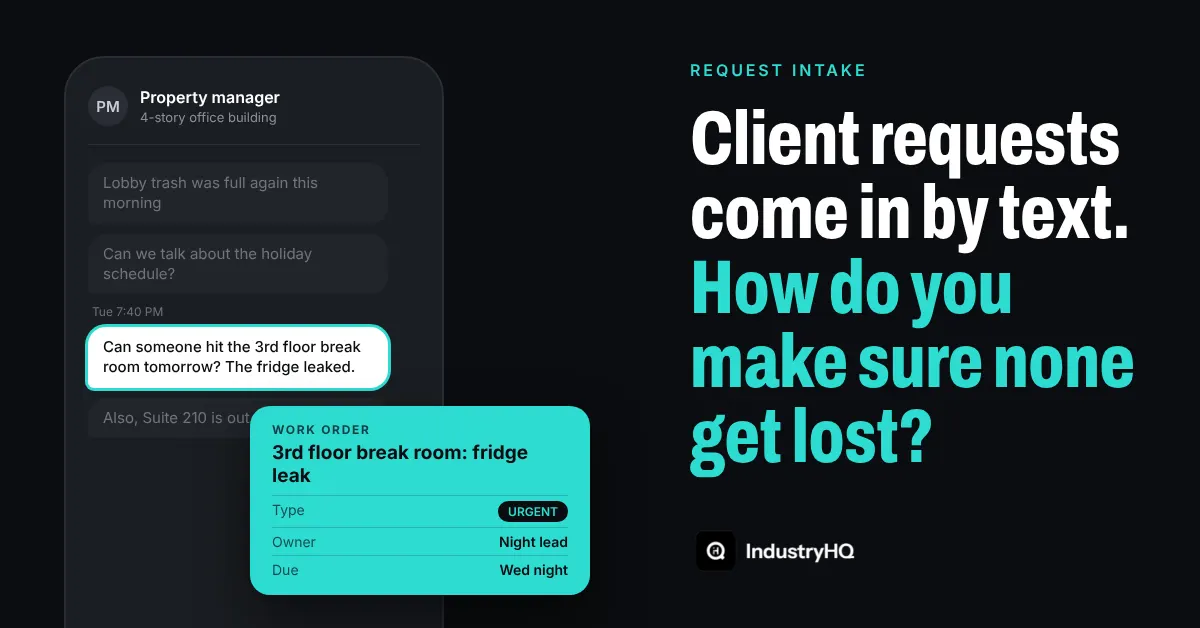
- Requests come in through too many channels. A client texts a supervisor, emails the office, and mentions something to a cleaner on site. Nobody has the full picture.
- Inspections happen rarely. Many companies walk each building once or twice a year, often right before a renewal. That's a snapshot, not a trend.
- Fixes aren't confirmed. Someone says "I'll take care of it," and maybe they did. There's no record either way.
Put those together and the client becomes your inspector by default. They see the building every day while you see it when something goes wrong.
What is a quality loop for commercial cleaning?
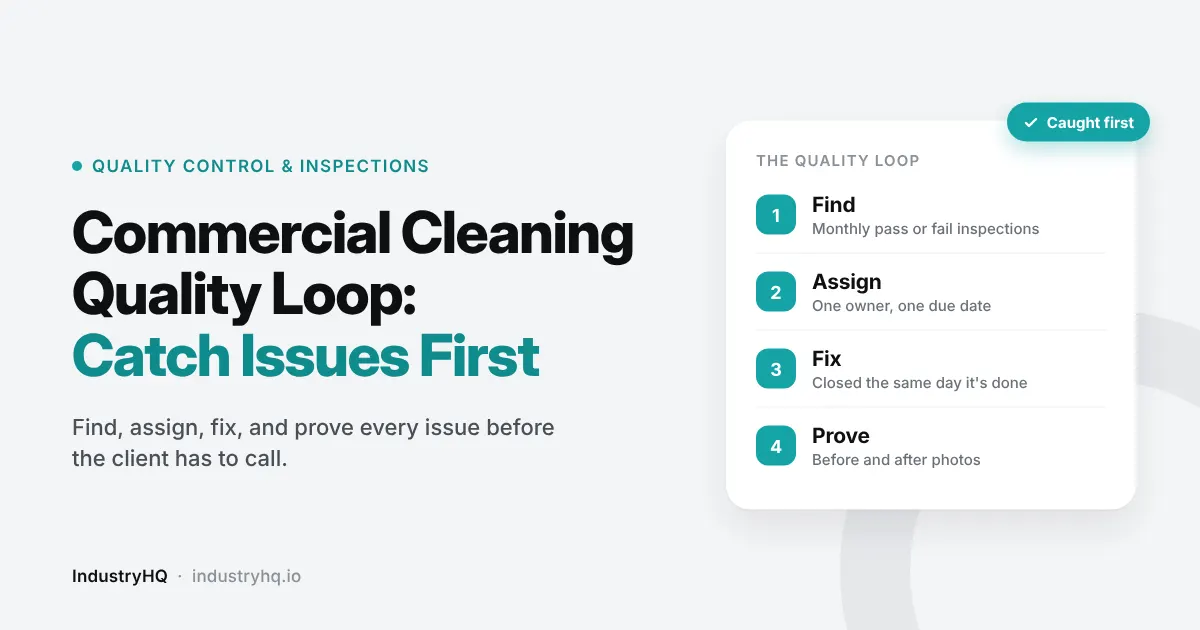
A quality loop is a repeatable process for finding, assigning, fixing, and documenting issues at every building you clean. Companies that rarely get complaint calls tend to run the same basic loop, whether they use paper or software. It has four steps: find, assign, fix, and prove.
1. Find: How often should you inspect each building?
Inspections are how you see a building the way the client does. The biggest improvement most companies can make is frequency. Moving from a yearly walkthrough to a monthly inspection gives you 12 looks at each building instead of one, and lets you spot a site that's slipping before it becomes a complaint.
To keep monthly inspections realistic:
- Use one standard checklist for each building type, so results are quick to record and easy to compare.
- Spread inspections across the month. If you have 40 sites, that's about 10 a week, not 40 in the last few days.
- Mark each item pass or fail, and track failures over time. A restroom that fails the same item two months in a row is telling you something.
Pay extra attention to restrooms. Facility cleaning managers report that restrooms account for almost half of all occupant complaints, according to Facility Cleaning Decisions’ 2024 Complaints Survey.
2. Assign: What should a cleaning work order include?
An issue that isn't assigned to someone is an issue that won't get fixed. Every deficiency from an inspection and every client request, no matter how it arrived, should become a written work order with:
- One named owner, not "the night crew."
- A due date the client would consider reasonable.
- A clear description, ideally with a photo of the problem.
This is the step where most complaints are born. The client mentioned the stained carpet. Your supervisor heard it. But it never got written down, so it never made it onto anyone's list.
3. Fix: When should a work order be closed?
Closing a work order should mean the work is done, not that someone said they'd do it. Ask whoever completes the fix to close it the same day, with a short note on what was done.
Review open items weekly. Anything past its due date gets a direct follow-up. A short list of overdue work orders is the most useful page a supervisor can look at each Monday.
4. Prove: Why do before-and-after photos matter?
Proving the work is a real gap in this industry. In CMM’s 2024 Building Service Contractor Benchmarking Survey, nearly 1 in 4 cleaning contractors named validating cleaning results as a top business challenge.
A photo of the problem when it's found and another when it's fixed changes the conversation with clients. Instead of "we took care of that," you can show exactly what was done and when.
Photos also protect your crews. When a client questions whether something was cleaned, a time-stamped picture settles it without anyone having to defend their work from memory.
What does the quality loop look like in practice?
Here's how the loop plays out at a hypothetical medical office building.
On the March inspection, the supervisor marks two restroom items as failed. Grout lines are dark and one partition has a sticky residue. They take 2 photos and create a work order for each issue, assigned to the night lead, due within the week.
The night lead handles the partition the next evening, adds an after photo, and closes the order. The grout needs a deeper scrub, so the supervisor plans it for Saturday. That order closes 4 days later with its own before and after photos.
When the supervisor sends the client the monthly inspection report, it shows both issues found, both fixed, and the photos to prove it. The client never had to notice the grout. If they had, the answer would have been ready.
Now picture the same building without the loop. The supervisor notices the grout in passing and mentions it in a group text. It gets lost. Six weeks later the office manager emails a photo of their own, and you're on the defensive.
Should you share inspection reports with clients?
Many companies treat inspections as an internal tool. Sharing a simple monthly report with each client is one of the easiest ways to build trust. It shows them you're checking their building on your own, not waiting to be told.
Keep it short: the overall score, any issues found and their status, and a few photos. Clients rarely read every line. What they notice is that it arrives every month.
A record like this also helps you win new business. Prospects who left their last cleaning company over problems that never got resolved want to know how you're different. A history of documented fixes is a far stronger answer than a promise.
How do you get started this month?
You don't need to roll this out everywhere at once. Pick your 5 most important accounts and run the loop for one month:
- Inspect each one with a standard checklist.
- Turn every issue into an assigned work order with a due date.
- Require a photo when each one closes.
- Send each client a one-page summary at month's end.
After a month, you'll know which buildings need attention and you'll have a routine worth expanding to the rest.
Frequently asked questions
How often should commercial cleaning sites be inspected?
Monthly is a realistic target for most accounts. A monthly inspection gives you 12 looks at each building a year instead of one or two, so you can spot a site that's slipping before the client does.
What should a cleaning work order include?
Every work order needs one named owner, a due date the client would consider reasonable, and a clear description, ideally with a photo of the problem. When the work is done, it should be closed the same day with a note and an after photo.
What should a client inspection report include?
Keep it to one page: the overall score, any issues found and their status, and a few photos. Sending it every month shows clients you're checking their building on your own. It also gives you a documented track record to show prospects.
Should cleaning inspections be pass or fail?
Pass or fail keeps inspections fast and clear: each item either meets the standard or it doesn’t. Track failures over time, since an item that fails two months in a row points to a problem worth fixing at the source.
What's the best way to track cleaning quality issues?
Keep every inspection, client request, and work order in one system instead of spread across texts, emails, and phone calls. Whether you use paper or software, every issue should have an owner, a due date, and a record of when it was fixed.
Where IndustryHQ fits
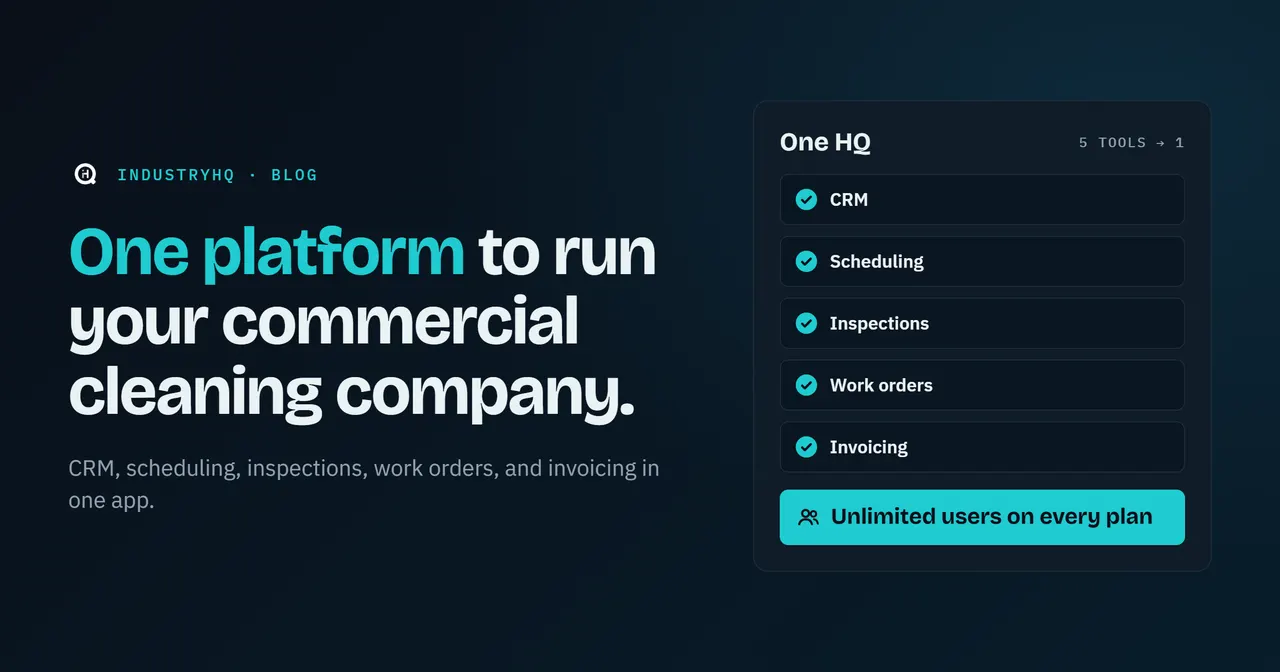
**IndustryHQ **is operations software for commercial cleaning companies, and it puts the whole loop in one app. Supervisors run pass or fail inspections with your checklists, turn any failed item into a work order with photos attached, and send clients a standard report. Every open item has an owner and a due date in one place, instead of in a text thread. Unlimited users are included on every plan, so every cleaner and supervisor can close out their own work.
Start a free 14-day trial or book a demo at industryhq.io